- Room-to-corridor pressure
- Zone and building pressure
- Positive and negative relationships
- Pressure stability under operating conditions
05 / Services
The right pressure. In the right direction.
Pressure VerificationThe capability
Pressure Verification
Small pressure differences can determine whether air moves into or out of a room as intended. Specialized measures and documents those relationships, evaluates stability, and connects the results to airflow, exhaust, controls, and building operation.
- Rooms losing required pressure
- Odor or contaminant migration
- Door operation and envelope issues
- Critical or controlled environments
Measured performance. Clear answers.
Commercial building pressure testing
Field-verified information for owners, engineers, contractors, commissioning providers, and facility teams.
Verify positive and negative pressure relationships
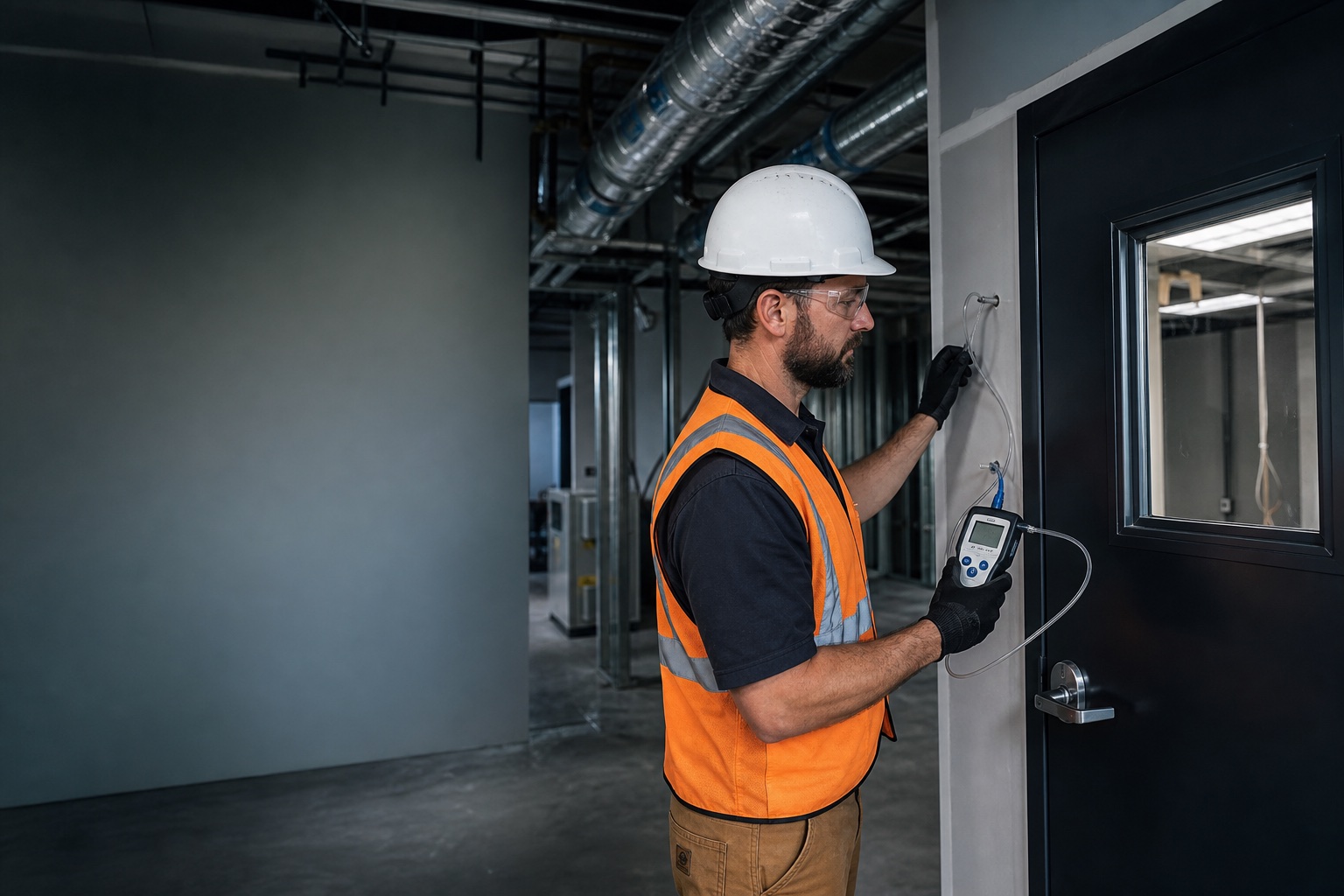
Pressure verification establishes the direction and magnitude of the air-pressure relationship across a room boundary, building zone, or exterior envelope. Depending on scope, Specialized uses sensitive differential-pressure instruments and directional-airflow observations to document behavior at the specified test condition.
A positive room pushes air toward the adjacent area; a negative room draws air inward. The correct relationship depends on the room design and use. We measure the field condition and compare it with criteria supplied for the project.
Connect pressure readings with actual airflow
Pressure is an outcome of air balance, control, openings, leakage, and weather—not an isolated setting. Supply, return, exhaust, relief, transfer paths, door undercuts, envelope leakage, wind, stack effect, and fan schedules may all change a reading.
When pressure is incorrect or unstable, related airflow and operating observations can help narrow the issue. This prevents the team from treating a single number as the whole problem and gives better direction for controls, mechanical, architectural, or facility follow-up.
Room, zone, and building pressurization testing
Pressure testing supports healthcare and laboratory rooms, odor-control areas, commercial kitchens, process spaces, vestibules, tenant zones, and whole-building concerns. It may be performed during turnover, after renovations, in response to complaints, or as periodic verification.
Specialized records relevant test boundaries and operating conditions with the measured relationship. Clear documentation allows the team to understand what was tested and which surrounding conditions may affect repeatability.
How the work progresses
A disciplined field process
- 01Define the pressure boundary, intended direction, and criteria
- 02Establish and record fan, control, door, and adjacent-space conditions
- 03Measure differential pressure and observe airflow direction
- 04Compare pressure with related supply, return, exhaust, and transfer airflow
- 05Repeat representative conditions and document results
Common questions
Pressure Verification FAQs
What is the difference between positive and negative room pressure?+
Positive pressure drives air from the room toward the adjacent space; negative pressure draws air into the room. The required direction and magnitude come from the room design and applicable criteria.
Why does room pressure change when a door opens?+
An open door creates a large transfer path that reduces the pressure difference. Door cycling, seals, closers, and surrounding pressure relationships also affect recovery.
Can building pressure cause door problems?+
Pressure may contribute to doors that are hard to open or close, but hardware, alignment, closers, wind, stack effect, and envelope conditions should also be evaluated.
Is a smoke test the same as differential-pressure testing?+
No. Directional smoke shows airflow direction at a boundary, while an instrument provides a quantitative differential-pressure reading. The appropriate method depends on scope and criteria.
Put the right measurements behind the next decision.
Tell us about the building, system, schedule, and scope. Specialized will help define the field verification your project needs.
Request a proposal ↗Next capability
Explore service ↗